Ernst van den Hemel

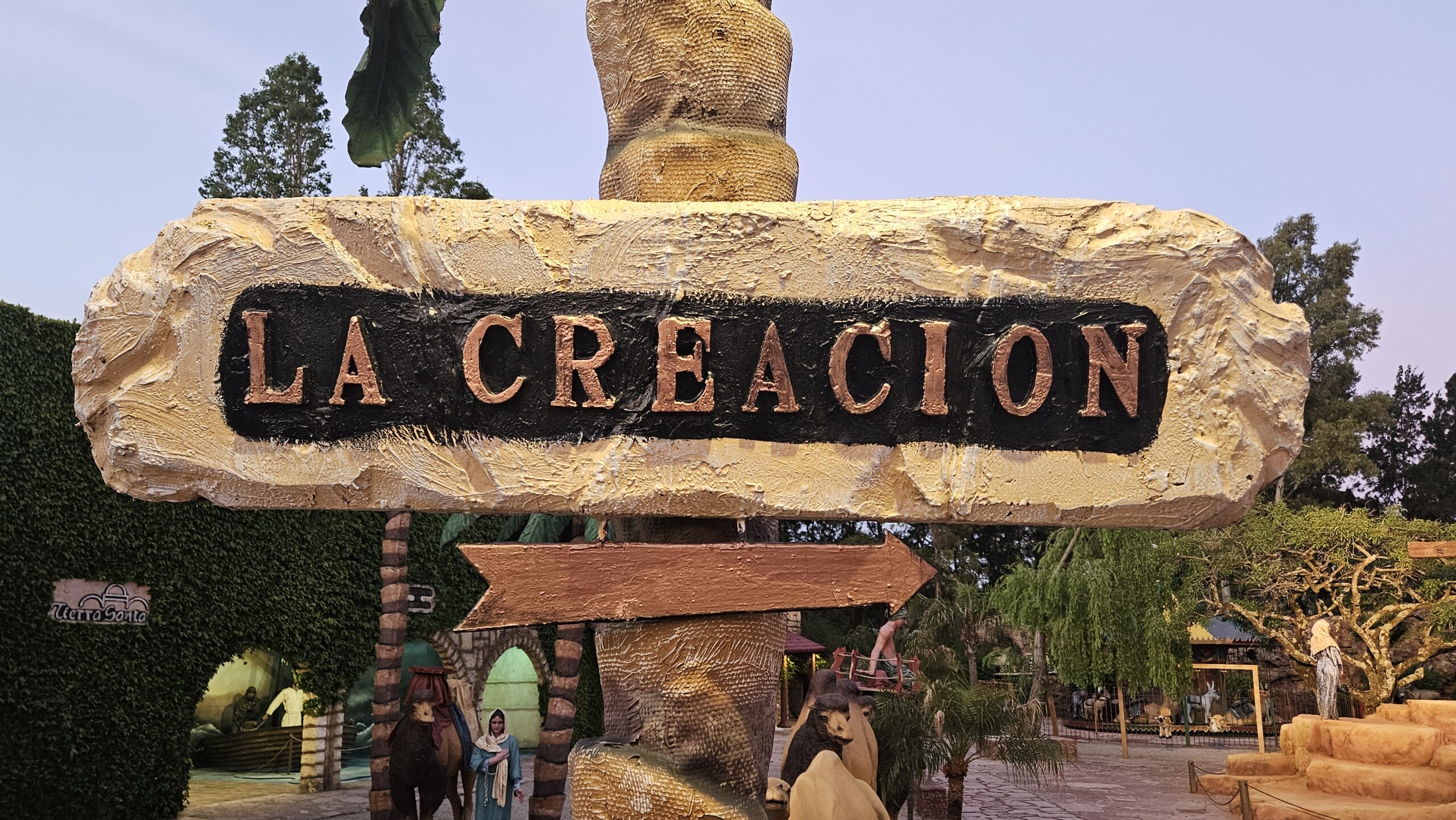
“You, the visitor, are entering the first religious theme park, the only one in the world dedicated to the Holy Land, where you play the leading role in the history, culture, customs, and traditions of two thousand years ago. You are taken back in time and experience a miraculous journey.” This sign stands at the entrance of Tierra Santa in Buenos Aires, Argentina. The park, opened in 1999 and consecrated in 2000 by the Archbishop of Buenos Aires (the future Pope Francis), offers visitors the opportunity to walk around Biblical Jerusalem.
The park contains hundreds of statues depicting Biblical scenes: the betrayal of Jesus by Judas, Pontius Pilate washing his hands, Jesus riding into the city on a donkey. Employees, dressed in vaguely Biblical costumes, wander among buildings meant to represent Jerusalem. We see, among other things, a Roman temple, a synagogue, and a marketplace. A Hebrew temple stands next to a replica of the Western Wall. The overall effect is meant to give visitors the impression of walking through Biblical times. The entrance gate even proclaims: “Visit Jerusalem all year round in Buenos Aires.”
The park also depicts more recent figures—statues of Martin Luther, Pope John Paul II, Mother Teresa, and Mahatma Gandhi. A mosque stands across from the synagogue. There is also a photographic display documenting Pope Francis’s visit to Israel. In this way, the park interweaves Biblical history with more contemporary events.


In addition, various multimedia shows are performed. Every hour, a creation show takes place in which lasers (“And God said: let there be light”), animatronic figures, and special effects depict early creation up to the Fall. Visitors can also attend the Last Supper, where an animotronic statue ofJesus and his disciples sit at the table. Inside a mountain made to resemble Golgotha, visitors are invited to take selfies with a larger-than-life image of Jesus.The most spectacular part of the park is perhaps the resurrección: every hour a loud gong echoes through the entire park, and a twenty-meter-tall statue ofJesus slowly rises above Golgotha. Meanwhile, the famous “Hallelujah” chorus from Handel’s Messiah plays.
The park is thus partly a representation of historical Biblical Jerusalem, but also a place of entertainment, where elements from our own time appear and a mixture of techniques is used to evoke wonder. Historical re-enactments, light and sound shows, and animatronic figures are all employed. The park’s aim is to introduce people to the Catholic faith in an entertaining way, strengthen Catholics in their faith through multimedia experiences, and offer an alternative to secular theme parks and tourist destinations.
For some, Tierra Santa sounds like an exotic place, where the combination of attractions and spirituality may come across as somewhat odd. But placed in a longer history in which entertainment and religious pedagogy often go hand in hand, the existence of Tierra Santa is not so strange. As we already wrote elsewhere on this blog, a theme park is characterized by the use of multimedia techniques to entertain and to offer a responsible form of amusement. Theme parks generally do not see themselves as mere entertainment: they use attractions to tell a story (the theme) to their visitors. Tierra Santa thus fits among parks that try to convey a message through entertainment and compete with other forms of leisure. When it was founded in 1952, the Efteling was a park that offered entertainment “in a Catholic spirit,” Disney’s parks provide responsible amusement by telling fairy tales with moral lessons, the small churches and mosques of Madurodam and Miniatürk are meant to inspire interest in the nation, and Dollywood blends “Southern charm” with Christianity and the story of Dolly Parton. Moreover, in the United States, from 1978 to 1989, there was also the park Heritage USA, a theme park/water park with an explicitly Christian theme.
Earlier in history as well, all sorts of immersive media were combined with religion. In the Netherlands, near Nijmegen, the Heilig Land Stichting has existed since 1911. The park was previously called the Biblical Open-Air Museum and now goes by the name Museumpark Orientalis. The park was built to resemble the Holy Land as closely as possible. There is a Golgotha, a Roman city street, and visitors move among costumed staff who provide an immersion into the Biblical world. Such devotional parks existed decades before Tierra Santa. Is this so different from what Tierra Santa offers its visitors?

Even further back in history we find more places that resemble what Tierra Santa does. In the early modern period and the Middle Ages, there were places where Biblical realities were depicted. Francis of Assisi built the first nativity scene in 1233, using life-sized figures to represent the birth of Jesus. The public marveled at the lifelike and moving display. Here too, figures and staging were used to transport visitors to the Holy Land. This became a popular practice when, due to Ottoman conquests, pilgrims could no longer travel to the real Holy Land. In the fifteenth century, “Holy Mountains” (Sacri Monti) were created, such as the one established in Piedmont in 1486, featuring dozens of chapels that depicted the Holy Land. This tradition expanded in the seventeenth and eighteenth centuries. Monastery gardens were transformed into Passion and Marian parks, and reconstructed Lourdes grottoes, Calvaries, and other holy places appeared throughout Christian Europe. Tierra Santa therefore fits into a long tradition of recreating scenes from the Bible to enchant people and teach them something in the process.
And what about non-Christian religions? Buddhist and Hindu pilgrimage circuits allow visitors to walk symbolically through the cosmic universe. In Buddhism, sculpture gardens depicting the Buddhist hell have existed for centuries, allowing people to walk through these representations. Such hell parks still exist today, for example in Thailand, Malaysia, and other countries in Southeast Asia. In Indonesia, there are Islamic miniature Meccas or “Hajj simulations” for believers who cannot travel to the real Mecca. And in Japan, miniature versions of the 88-temple route (Shikoku) can be found in city gardens or temple complexes.
In short: isn’t the phenomenon of the religious theme park much older than Tierra Santa? In one sense, yes — for centuries, parks and environments have been created in which people are immersed in a reconstructed religious world. On the other hand, it would be a stretch to call a medieval nativity scene or a Buddhist sculpture garden a theme park. After all, the word theme park refers to something modern: experience-oriented tourism.
Perhaps the question is not so much which park is the first religious theme park, but rather which park describes itself as one. The Efteling or Disney would not be likely to use that label. Museum Orientalis initially presented itself as a devotional park, later as an open-air museum, and finally as an “experience park,” but it still considers itself more a museum than a theme park. Tierra Santa, by contrast, explicitly claims to be a religious theme park and thus positions itself deliberately within the theme-park tourism market. In doing so, it exemplifies how, in the twenty-first century, the boundaries between popular culture and religion are blurring in new ways.
Ultimately, the question of which park came first may not be the most interesting one. What makes Tierra Santa particularly remarkable is that it shows how contemporary religion continually connects with modern cultural forms in new ways. In Tierra Santa, all kinds of media forms come together in an attempt to spark and guide the audience’s imagination. All over the world there are countless places where immersive media are used to express religion. These techniques move between entertainment, religion, and heritage — a fascinating field to study because it reveals how religion and imagination influence one another. It also shows that there is an intriguing history to be written in which religion and popular culture are not opposites, but constantly shape each other in a struggle for our attention, imagination, and entertainment. Theme parks attract hundreds of millions of visitors each year, and in this hugely popular entertainment industry, religion also takes on new forms.
To return to Tierra Santa: the twenty-meter-tall Jesus who rises from Golgotha every hour may elicit a chuckle. But the park is not so different from others that compete for our attention in today’s experience economy. What does make it unusual is that it offers a glimpse into the global media struggle for our imagination — a struggle in which lasers, animatronic figures, and selfies all play their part.
Curious? We film our visits with 360-degree cameras. In the video below, you can take a look inside Tierra Santa; move your phone or drag your cursor to look around:
 English
  Dutch
Dutch