Kai Shmushko
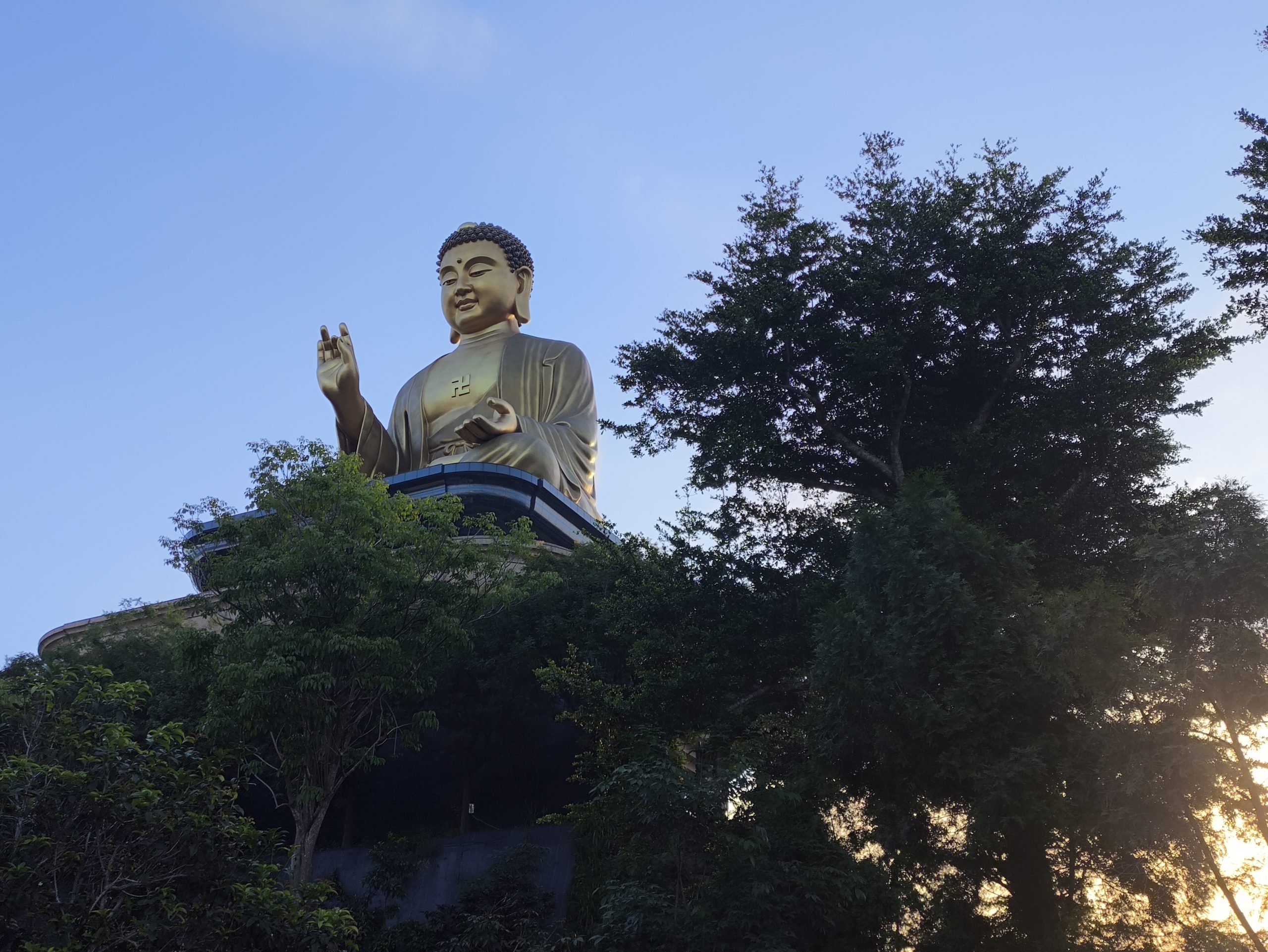
Standing on the rooftop balcony of the Fo Guang Shan Buddha Memorial Museum in Taiwan, I was humbled by the immense size of the monumental Buddha statue above me. Whether I strolled along the long garden path leading to the museum, visited the exhibition halls and temples, or explored the pagodas featuring various activities, I felt an overall sense of awe.
Perhaps it is, to begin with, the magnitude of the site and its features that leaves visitors bewildered, referring to the Museum online and across the country as a ‘must-see experience’. In heritage places and theme parks, size is often used as a tool for structuring the experience of visitors and worshippers. Some heritage-related theme parks today experiment with size by downscaling monuments and landscapes, (as explored by MAKEBELIEF colleagues in their research on miniature parks, see here and here). Here however we see not the miniature, but the immense as a key ingredient in experiences of awe and wonder. In this blogpost I explore the Fo Guang Shan Buddha Memorial Museum and how it offers a remarkable combination of religion, history and entertainment.
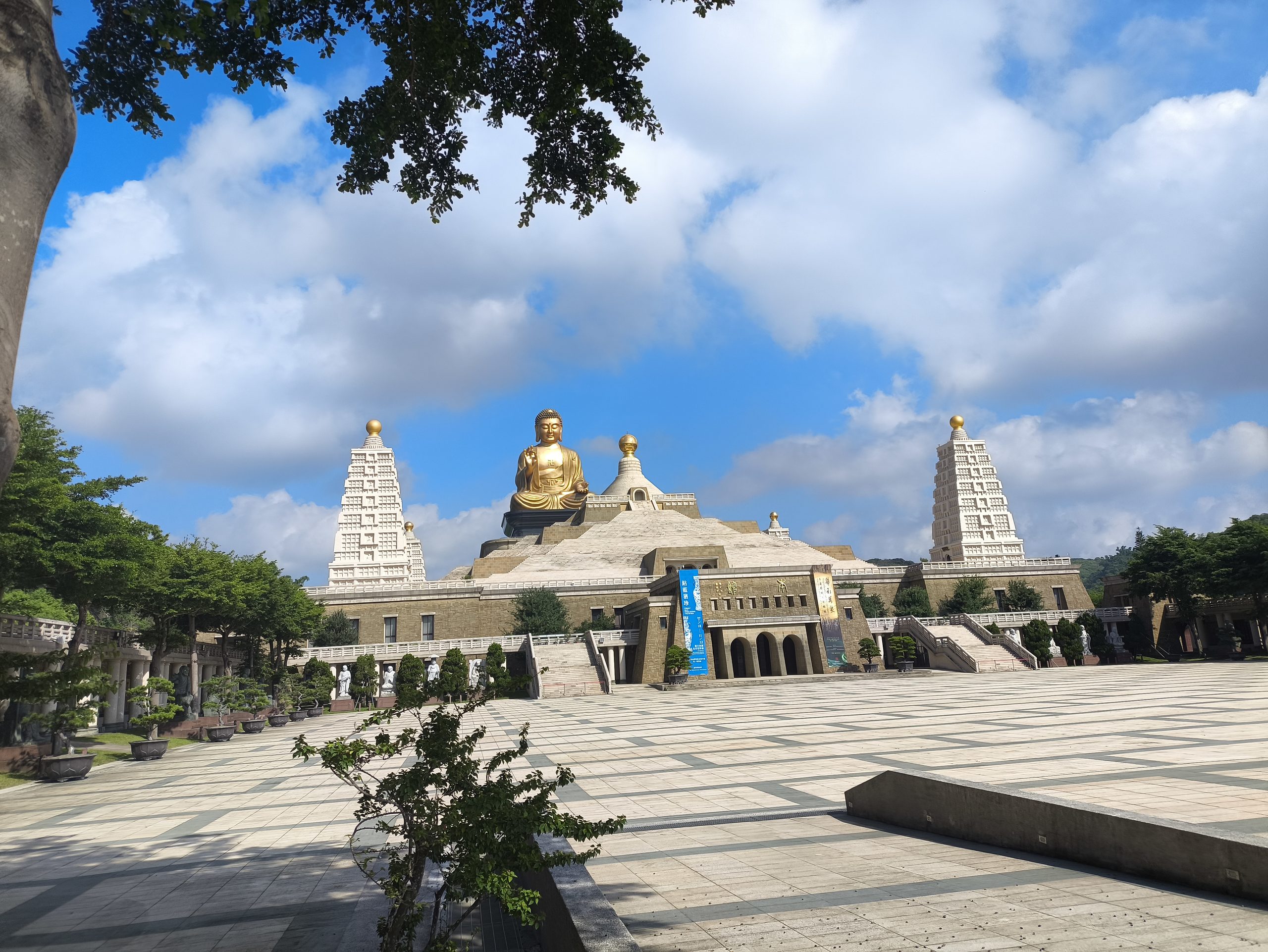
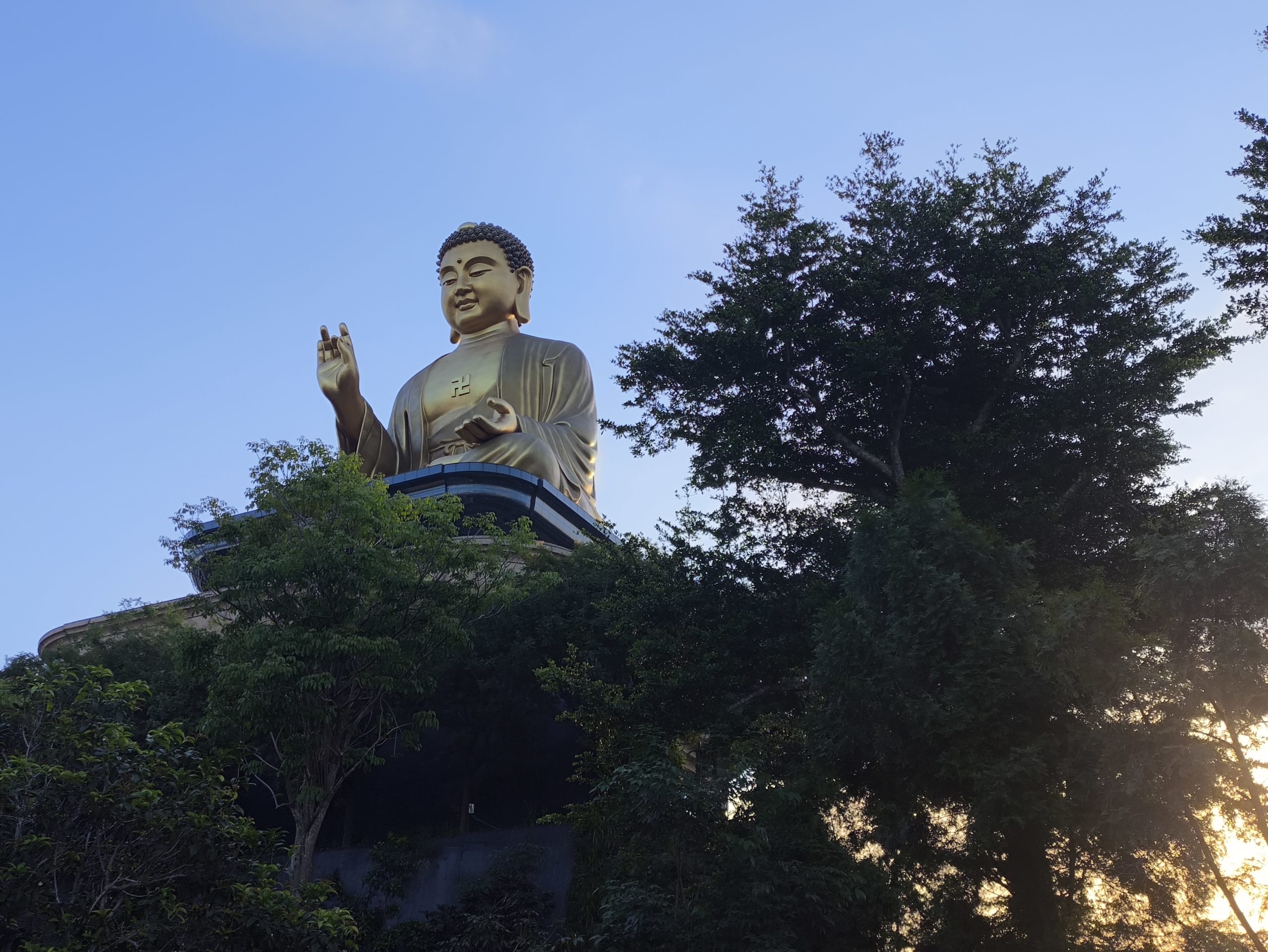
The giant Buddha at the Fo Guang Shan Buddha Memorial Museum is 108 meters high. While it is a modern structure, it joins a long tradition of monumental Buddhist sculptures in China. Scale in Asian Buddhist themed sites is often understood as ‘the larger, the better.’ From the fifth century onward, the building of monumental ‘Big Buddhas’ (dafo 大佛), carved from rock, became a significant cultural and religious phenomenon across Asia. See for instance the stone carved Leshan Giant Buddha in Sichuan, which also has a theme park built next to it (But more on that in our future fieldwork reports).
There are many reasons behind the construction of giant Buddhas across the Chinese world. Historically, they are seen as reinforcing the authority of religious and political elites and as mediator between the mundane and the divine. They therefore carried both spiritual and political significance. In contemporary times, the role of the big Buddhas is not so different. Large Buddha monuments communicate prestige, inspire awe and amplify a sense of sacredness. But they also encompass monetary value, attracting religiously inspired visitors and tourists to commercial religious and heritage sites.
The magnitude of the statue and museum and the size of the Museum also reflects the global reach of Fo Guang Shan (FGS, or “Buddha Light Mountain”). FGS is a religious movement of monks and nuns, lay Buddhists, and volunteers dedicated to adapting Chinese Buddhism to a modern, globalized world in the tradition of Humanistic Buddhism. FGS operates internationally, with branches around the world, including the He Hua Temple on Amsterdam’s Zeedijk. The FGS Museum in Taiwan is located next to the movement’s headquarters and monastery. Its founder, Master Hsing Yun (1927–2023), built the museum almost two decades ago to promote Buddhism and commemorate a historical relic of the Buddha: a tooth preserved after his cremation in Tibet (Tibetan lama Kung Dorje Rinpoche obtained the relic after the monastery where it had been stored was destroyed during the Cultural Revolution. In 1998, he gifted it to Hsing Yun in recognition of his global promotion of Buddhism).
The Buddha Museum and the Experience Economy
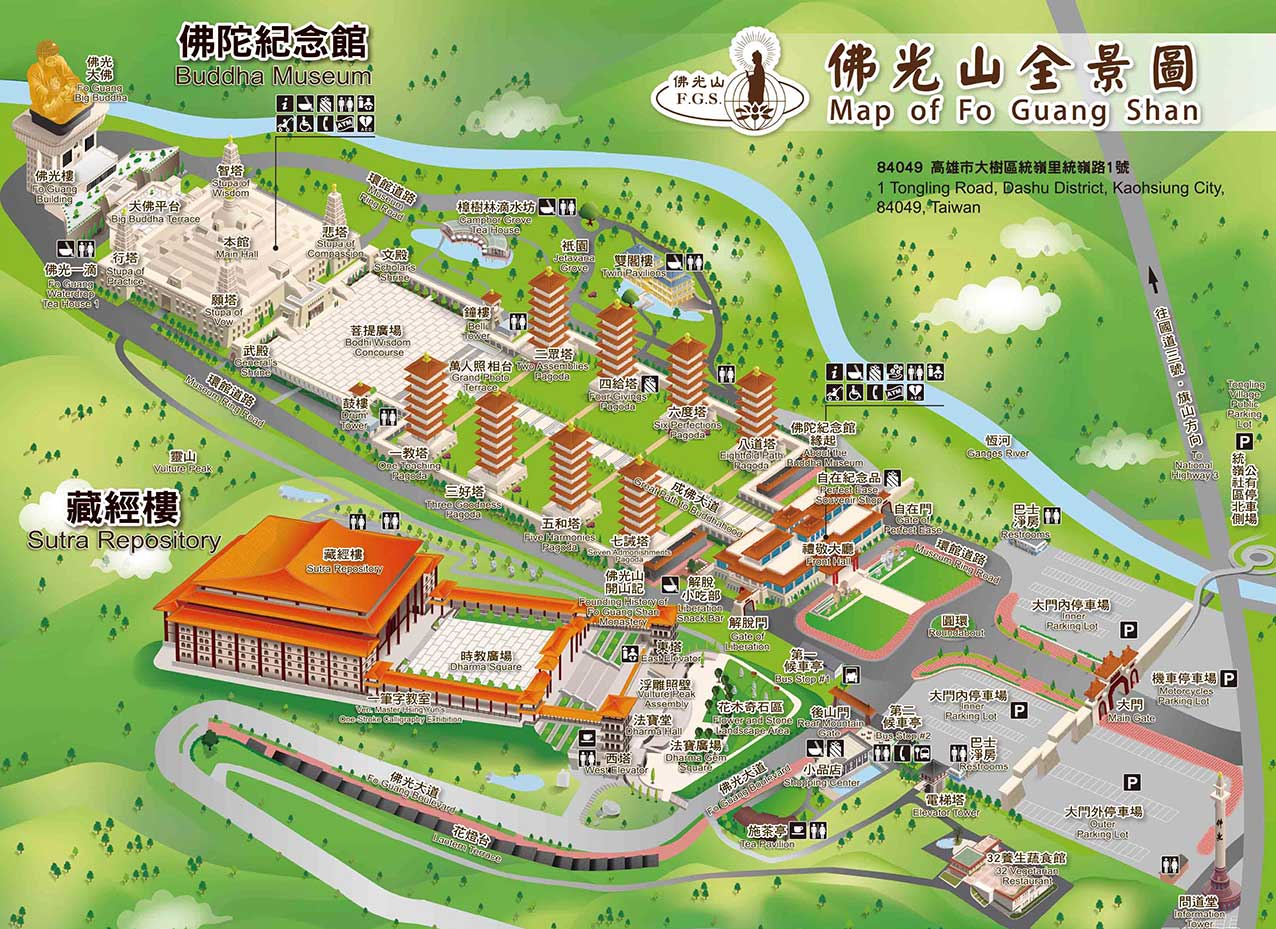
The Buddha Museum includes entertainment, religious education, historical preservation and immersive art exhibitions, all centred around Buddhism. The museum park, which took eight years to build, is grandiose and meticulously designed. Its immense scale and meticulous theming communicates an overall sense of abundance.
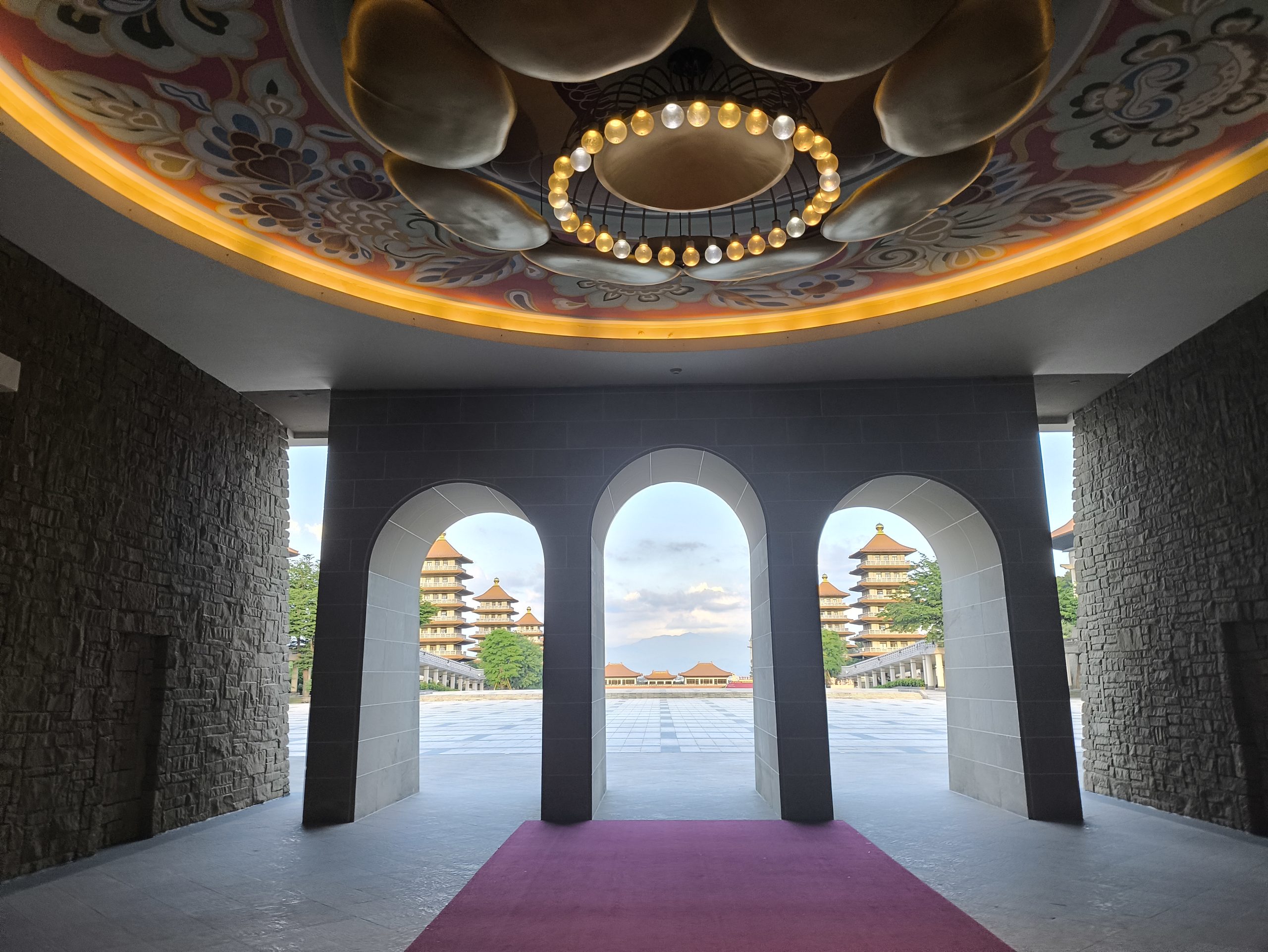
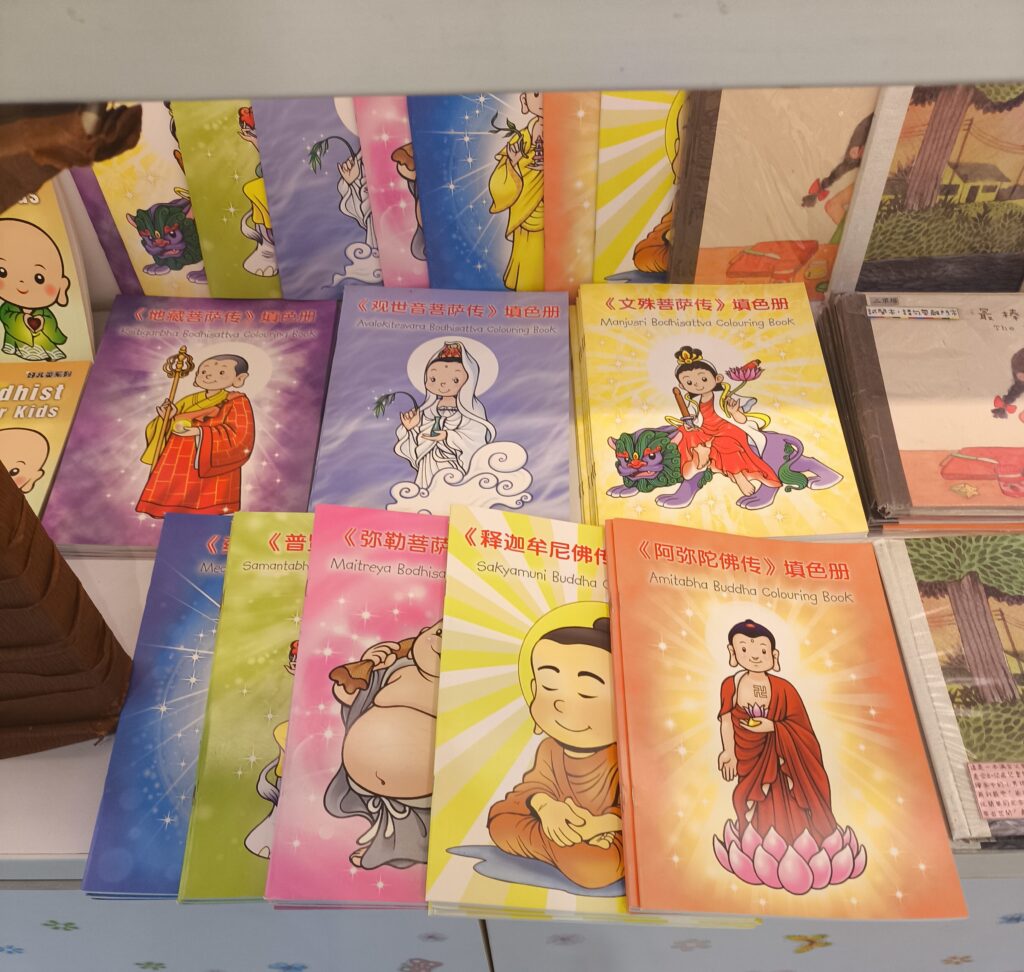
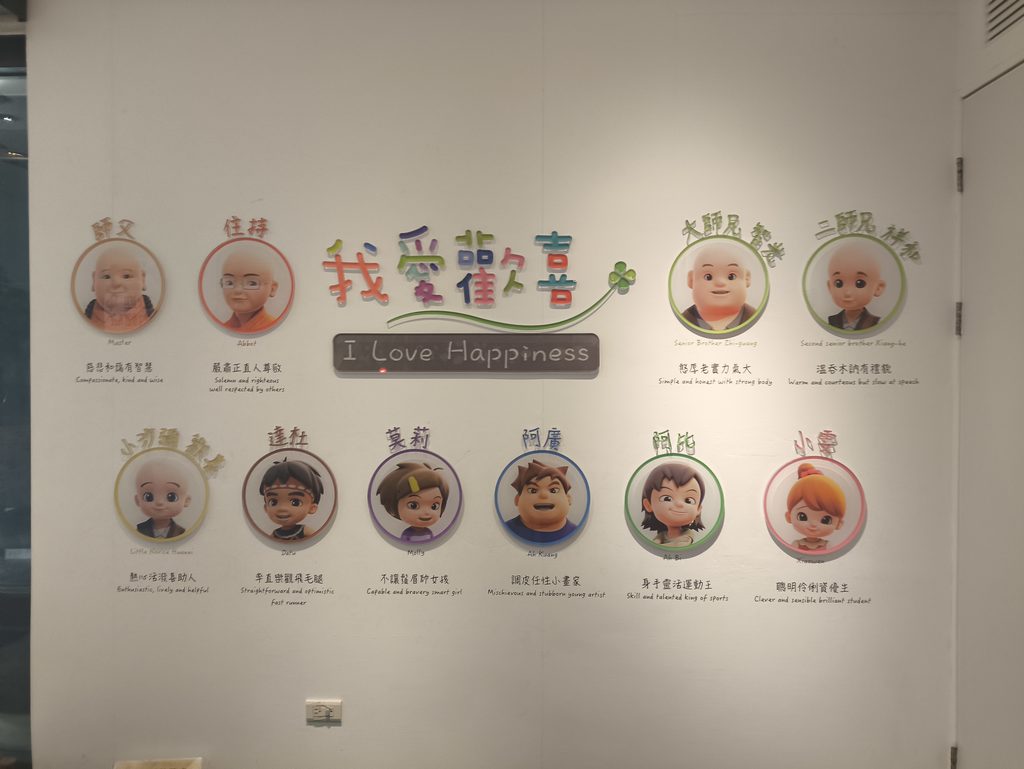
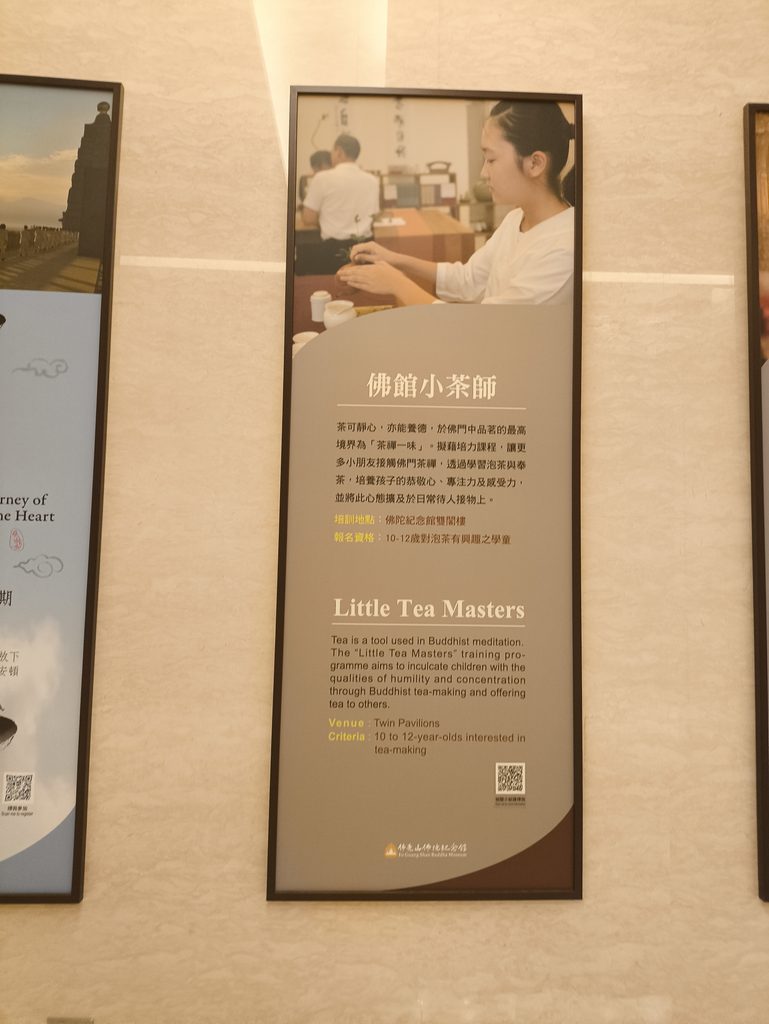
Visitors can stay in the hotel decorated with comic-style Buddhas. They can dine in various (vegetarian) restaurants and tea houses; from high-end dining to simple self-service canteens in which the food is prepared by resident nuns. The luxuriously designed entrance building contains shops selling a wide range of souvenirs and Buddhist-themed goods. The pagodas along the main avenue offer tea meditation workshops, while a children’s educational section provides games, films, and merchandise inspired by Buddhist philosophy. At the centre of the site stands the main museum hall, with permanent and rotating exhibitions engaging the visitors with Buddhist history, material culture and art.
Together, these attractions create a park that connects visitors to the historical and conceptual dimensions of Buddhism as well as to everyday practices such as food, meditation and tea ceremonies (on the relationship between Buddhism and tea see my chapter in Oxford Handbook of Lived Buddhism and interview for the newspaper Trouw). The site’s structure, and its close interaction with the neighbouring monastery, adds another layer to the experience: visitors encounter nuns not only in the museum, but also as tour guides, hotel staff, and cooks in the restaurants, offering a glimpse into monastic life.
Walking through all of this, I was reminded of scenes from Jurassic Park (1993). Its creator, John Hammond, proudly shows off his luxury resort and high-tech dinosaur zoo, repeatedly insisting that he has “spared no expense.” One might ask: but wait, isn’t Buddhism a religion centred around ascetic practices, the rejection of materialism, and retreat from the normal world of economic transactions? Shouldn’t Buddhists instead focus on spiritual cultivation and values such as frugality?
One way to understand this tension is to situate the museum within broader attempts to make Buddhism accessible and relevant in a period marked by Buddhism's recent decline in East Asia. At Fo Guang Shan, this means offering visitors multiple ways to encounter Buddhism—not only through worship or religious instruction, but also through food, leisure, shopping, art, and entertainment.
Pine and Gilmore’s concept of the ‘experience economy’ which we draw on in MAKEBELIEF to understand themed environments, offers a useful perspective on this development. They describe experiences as a distinct form of economic offering, alongside commodities, goods, and services. From this perspective, religious and heritage sites create value not only through what they display or sell, but through the experiences they stage. At FGS, Buddhism becomes something visitors can learn about, consume, photograph, practise, and temporarily inhabit.
Immersive Media at the Buddha Museum
The emphasis on making Buddhism approachable through a multisensory experience is illustrated by the immersive art exhibitions that are offered in the park. These ‘experiences’ use new media and digital technology to present the culture and history of Buddhism and engage visitors. But this also gives rise to new questions: what happens when you make the culture and history of Buddhism into a dazzling high-tech experience? Does this present a novel way of drawing visitors in, or does it result in a superficial spectacle? Two of the current exhibitions are vivid examples of this.
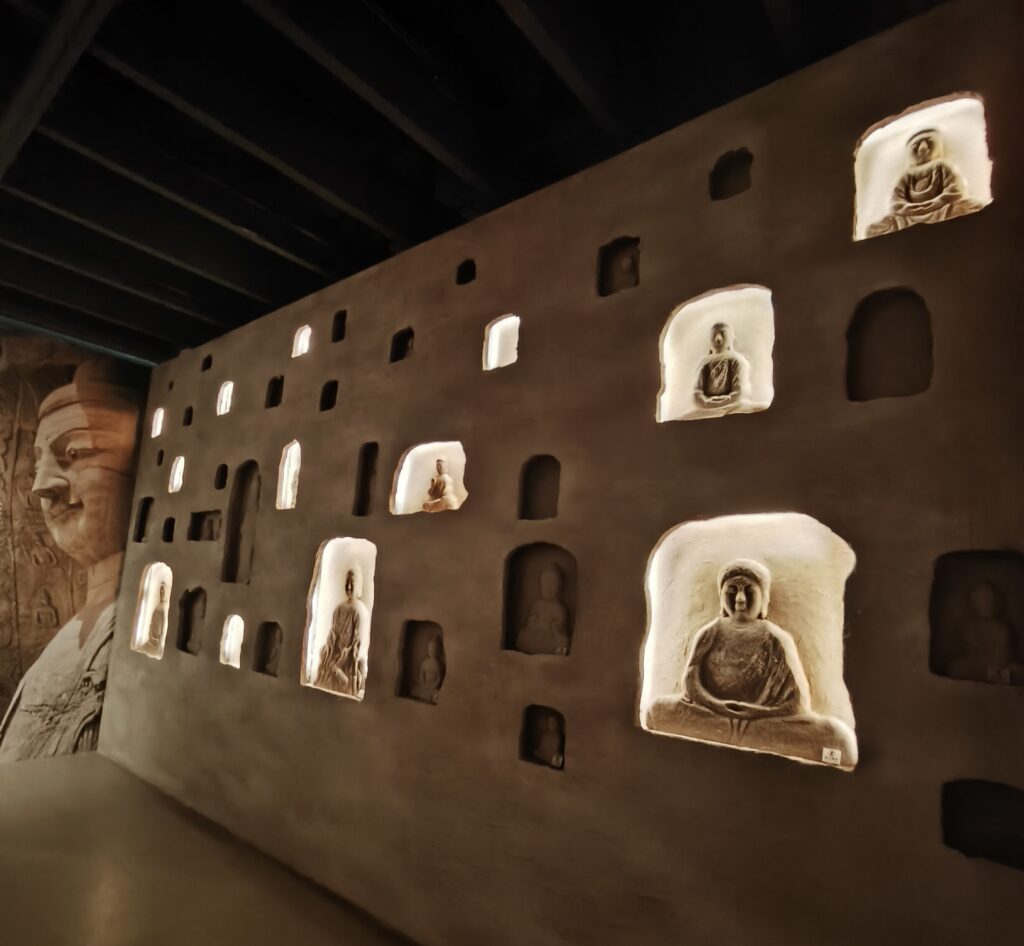
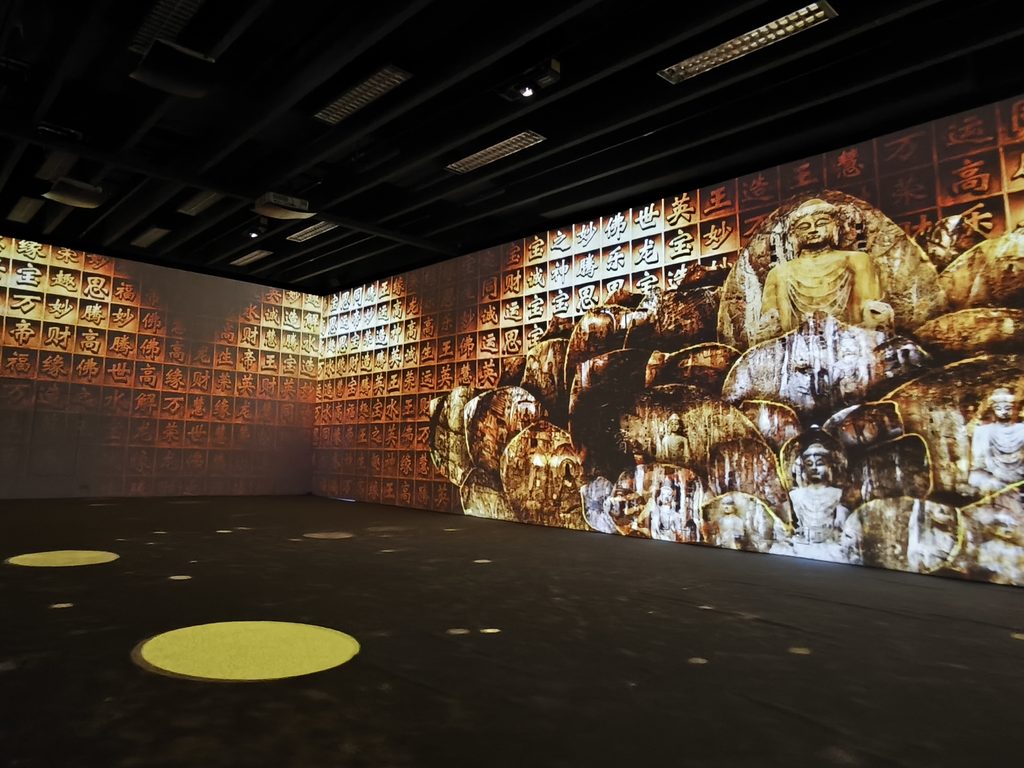
“Magnificence and Grandeur – Immersive Experience of Grotto Art” is an immersive light show projected onto four walls and the floor, bringing together five famous Buddhist cave groups in Mainland China, such as the famous Longmen and Dunhuang. It is framed as a “panoramic journey” through 1,600 years of Buddhist art and cultural exchange along the Silk Road. The exhibition includes a hall presenting real clay sculptures from the grottoes, while the digital adaptation enhances the visitor’s interest and engagement.
The technique that is used is similar to immersive art exhibitions and experiences across the globe: Colourful, bright, and vibrant immersive light installations have become increasingly popular in both private and public exhibition spaces for presenting new and historical artworks. Similarly, the five scenes of Grottos immerse visitors in a splendid visual dreamscape. The exhibit features beautiful texture, visual games and Buddhist inspired aesthetic images. The result seems to me, however, to be less an engagement with the actual sites and more a “wow” effect.
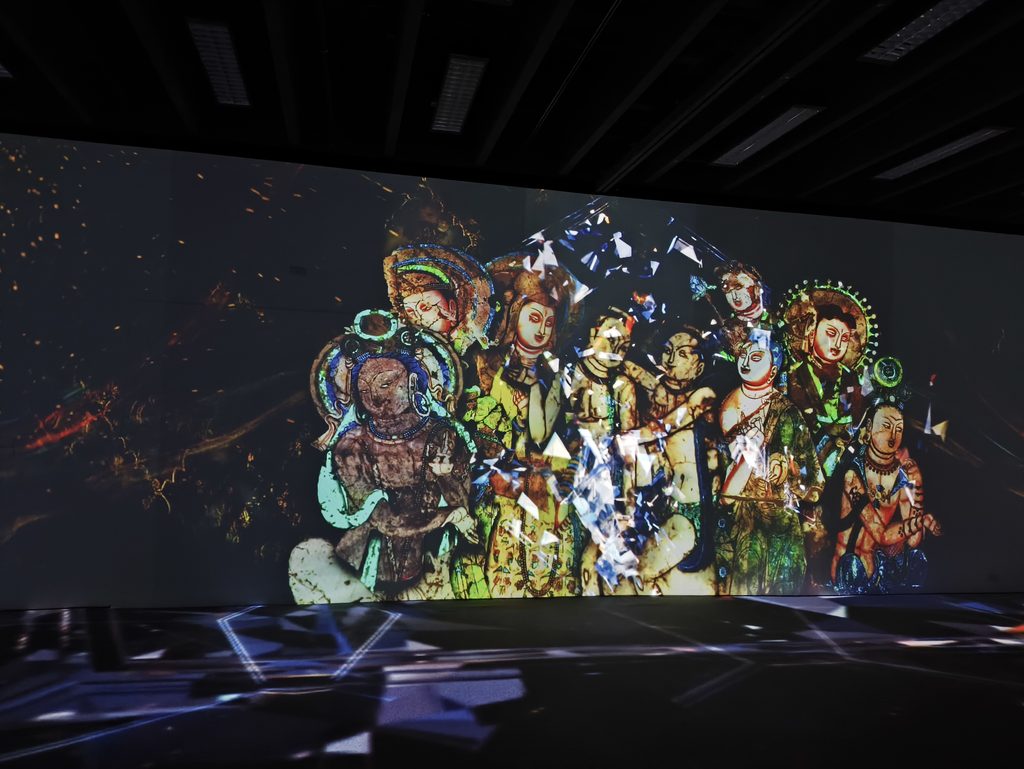
A different exhibition at the FGS Buddha Memorial Museum shows how immersive media can be more aligned with the purpose of the museum. The exhibition Buddhist Maritime Silk Road – New Media Art Exhibition, extended until 2030 due to its positive reception, uses cutting-edge media technology to recreate the historical and cultural processes of the Maritime Silk Road and the spread of Buddhism via waterways. Its most impressive highlight is a 360-degree pilgrimage to Buddhist holy sites along the coast. It presents 25 panoramic images projected in a panorama room, allowing visitors to virtually visit these sites.
Through clever use of filming angles, projection technology, mirrored 360-degree interactive theatre, and careful optical manipulation, an exquisite panoramic experience is created. As I moved from one site to another, I felt as if I was travelling between them, temporarily losing my sense of time and space. There was little narration, just me, in these Buddhist sites across East Asia. Here, the immersive medium seems particularly well matched to the subject: rather than simply showing visitors images of distant Buddhist sites, it creates the feeling of moving through them.
Starbucks and Authenticity
So, coming back from the pagodas and temples of Myanmar, Thailand, and Cambodia that I encountered through the 360-degree theatre, and looking at the museum site as a whole, how can we make sense of the experience of Buddhism that the FGS Buddha Museum offers? While the souvenir shops, activities, exhibitions, and restaurants might give the impression that the Buddha Museum is primarily a leisure site, the museum is, for many Buddhists, deeply sacred. The Museum park offers various ways to experience Buddhism for lay visitors and curious travellers, while religious authority and aura comes from the relic and monastery next door. Looking along the path leading from the entrance to the exhibition hall, I noticed visitors in the distance walking towards the entrance and, as they came closer, taking a bow. Some even performed full prostrations, lowering their entire bodies to the ground to pay homage to the Buddha. The park seems characterized by a tension between the sacred and the mundane, between spiritual profundity and commercial superficiality.
Perhaps the most symbolic feature through which to understand the tension between the different functions of the park is the large Starbucks coffee shop at the entrance. At first glance, Starbucks seems to disrupt the coherence of the story presented by the museum. The other shops, attractions, and activities appear carefully woven into a continuous Buddhist storyworld. Starbucks, on the other hand, introduces a global and secular commercial presence into this carefully themed environment. It would be easy to see the coffee chain as a Western, neoliberal establishment that disrupts the idealized Buddhist space created by FGS.
Yet this conclusion would be missing something. Rather than undermining the authenticity of the site, the museum’s commercialization may be part of its authenticity. Starbucks does not necessarily stand outside the Buddhist storyworld. It signifies that Buddhism is not an isolated or idealized tradition, but a lived and contemporary phenomenon, one that is already entangled with global capitalism, tourism, consumption, and popular culture. These entanglements between sacredness, spectacle, and commerce offer a rich field for further research—one to which we will return in future MAKEBELIEF fieldwork reports.
 English
 Dutch