Lukas Vonhout
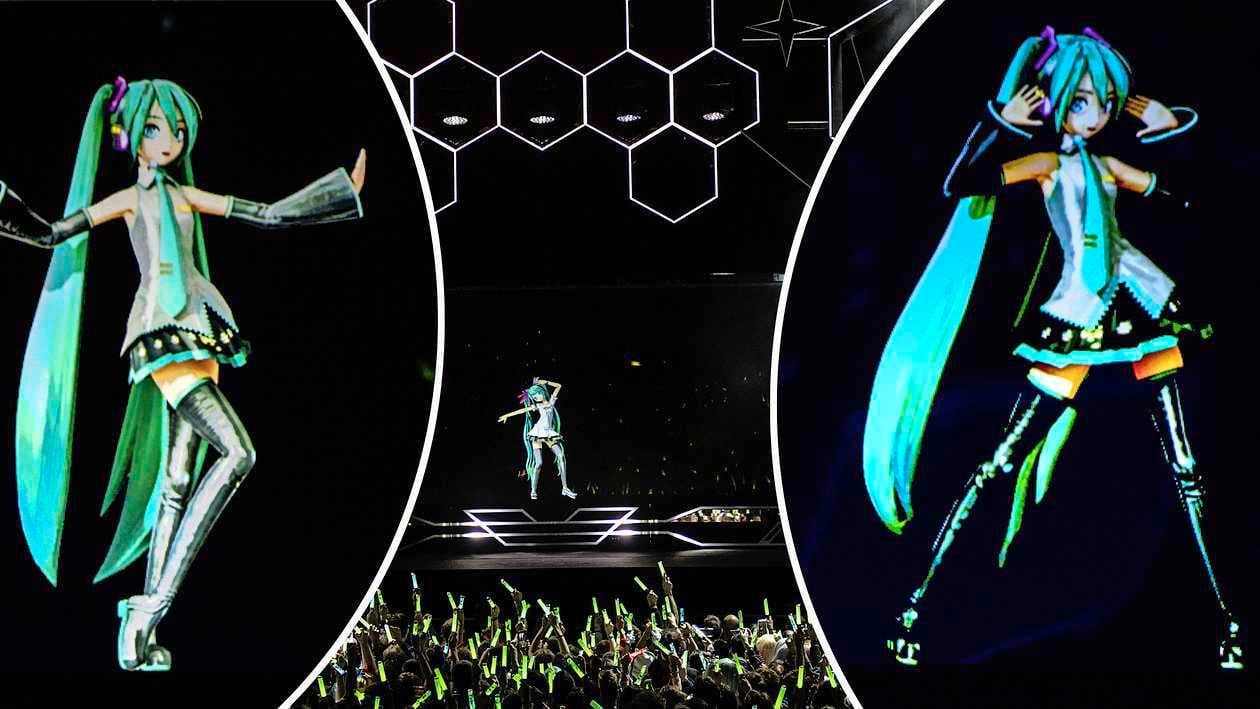
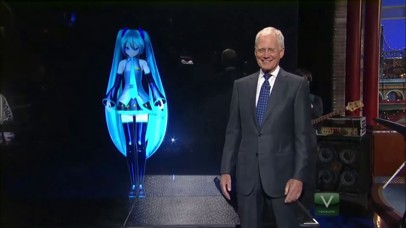
A girl with long blue hair travels the world performing to sold-out venues. Having opened for Lady Gaga, amassed millions of streams on YouTube and Spotify, appeared on David Letterman’s Late Show, and with more than a hundred thousand songs to her name, this sixteen-year-old artist can rightly be called a superstar. There is, however, something unusual about her: Hatsune Miku has been a sixteen-year-old superstar for almost twenty years. She is entirely digitally generated, from her voice to her physical appearance, appearing as a hologram or on an LED screen during live performances. Thousands of fans sing, dance, and cosplay as this digital pop star. When Hatsune Miku performed at a sold-out AFAS Live in 2024, the NOS described her as an artist “who does not exist at all”
The phenomenon of Hatsune Miku raises all kinds of interesting questions: What makes a hologram or virtual pop star feel “real”? What are the possibilities and limitations of this technology? And how should we think about her fans: as passive followers of a fake artist, or rather as co-producers? In this blog post, we dive into the world of this holographic Vocaloid sensation.
“The first Sound of the Future”
Hatsune Miku (初音ミク) means “the first sound of the future” in Japanese. This is how Crypton Future Media, the company that generated her voice, presents her: as the future of music. The company produces so-called Vocaloids, software that allows users to write melodies and have them performed. The software can be compared to a keyboard or synthesizer on which you can select different sounds, allowing you, for example, to switch within a second from a piano to an organ, or from an operatic voice to a bass guitar. Hatsune Miku’s voice is one such Vocaloid, based on recordings by voice actress Saki Fujita. Anyone who buys and downloads the software can write and produce a song using Hatsune Miku’s voice. In this way, every user can become part of the pop star’s repertoire.
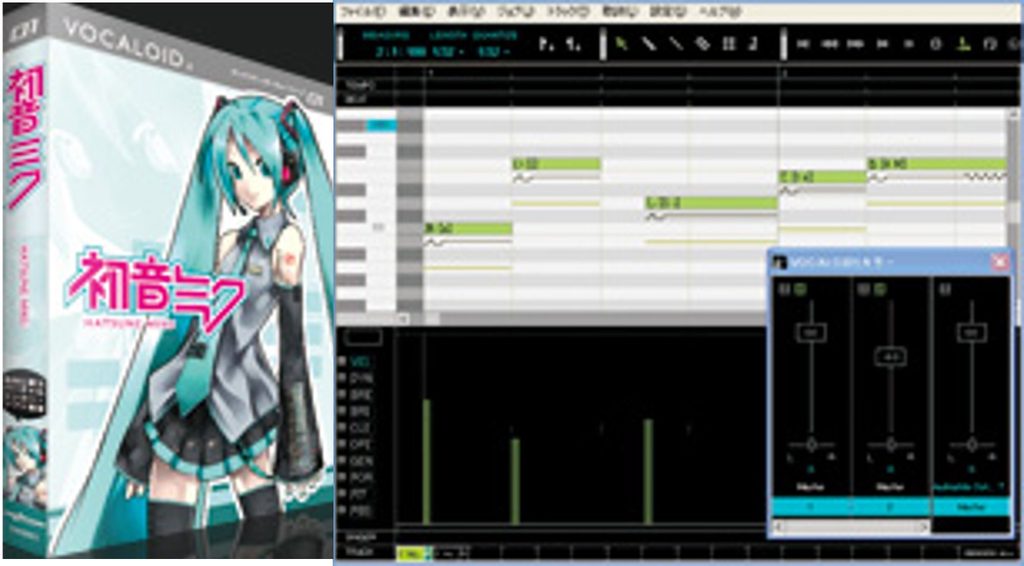
Because Hatsune Miku is therefore partly a product of her fans’ creativity, fans are not simply consumers, but also authors and producers. By now, the artist has more than one hundred thousand songs to her name, all created using Vocaloid software. vocaloid software.
A Hologram That Becomes Real
What makes a hologram or virtual artist feel “real”? What are the possibilities and limits of a virtual presence? As holographic musical performances become increasingly popular, these questions are becoming more relevant. A hologram of the late artist Tupac, for example, generated a great deal of reaction and emotion in 2012. This can still be seen in the YouTube comments beneath the video of the performance. Comments such as “giving me chills,” “did anyone else get shivers on their body?” and “I honestly would’ve cried” show how even a video of a hologram can provoke physical and emotional responses among fans and viewers (SnoopDoggTV 2012).


The same was true of a posthumous Michael Jackson performance, where viewers reported getting “goosebumps,” while one person described the hologram as “the spirit of the artist it represents” (Michael Jackson 2014).
Digital Boundaries
Alongside these emotional reactions from fans, holograms have also attracted criticism. In the case of Michael Jackson’s hologram, for example, some viewers have pointed to the computer-like way in which it moves, arguing that a hologram could never replace the real Michael Jackson. There is also a recurring sense that holograms of deceased artists carry something unsettling. The song “Slave to the Rhythm,” as performed by the hologram, takes on an almost literal and therefore ironic meaning: even after his death, Michael Jackson is brought back to life in order to produce money as a “slave to the rhythm” for major record companies (Michael Jackson 2014).


A hologram of someone who has already died can therefore work in different ways: it can create feelings of closeness, but it can also become uncomfortable when a deceased artist is brought back onstage and commercially exploited. With Hatsune Miku, this is partly different. Hatsune Miku, too, is a commercial product that invites consumers to feel emotions. But she is not a digital copy of someone who once physically existed. She was designed as a virtual artist from the outset and also invites consumers to produce music themselves. As a result, some of these ethical tensions are absent, while other possibilities emerge. Her digital nature creates space for co-creation, participation, and new forms of connection among fans. Let us therefore take a closer look at the fans’ experience.
Technology That Comes to Life
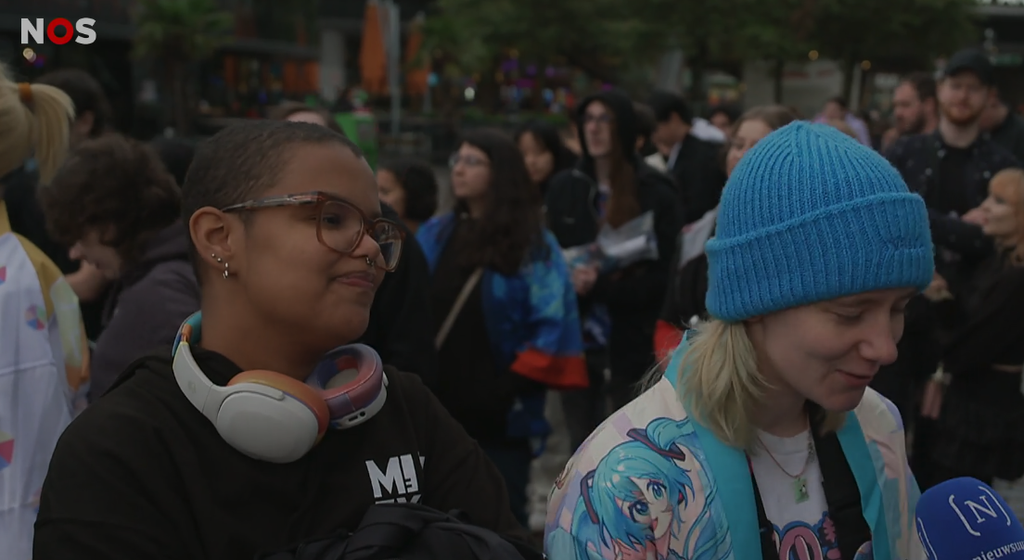
Fan: “I absolutely wanted VIP tickets because she isn’t here all the time.” Journalist: “But she isn’t here at all, is she?” Fan: “Yes, but in my heart she’s real.” Nieuwsuur 2024, 0:51–1:00
These are the words of a beaming Hatsune Miku fan waiting outside a sold-out AFAS Live, speaking to a Nieuwsuur journalist. Fans give similar answers when questioned by journalists from NOS. They repeatedly emphasize the importance of experiencing a performance together with other fans: it is not only the singing and dancing hologram onstage that creates the experience. Actively being present together and participating in the live performance is what allows Hatsune Miku to come to life inside AFAS Live. Another fan argues that, with the rise of AI in the music industry, Hatsune Miku actually offers an alternative: “I think [Hatsune Miku] is actually quite a bit more real than, for example, making something with AI,” the fan concludes (NOS Nieuws 2024, 0:39–0:54 & 1:14–1:34). This shows that, for fans, the phenomenon of Hatsune Miku is more complex than it may initially appear.
Virtual technology can thus be experienced by fans as alive and meaningful. This process can be understood through what Katherine Swancutt (2023, 7\) calls “technological animism” (Animism \| Open Encyclopedia of Anthropology): the attribution of spirit and human characteristics to technology. This term can help us make sense of digital developments such as holograms and Vocaloids like Hatsune Miku. We can see how fans play an active role in bringing digital media to life, and how even “non-existent” artists can become a source of community, authenticity, and even a counterweight to the perceived artificiality of AI. By analysing these processes, we see that the boundary between the virtual or digital and the physical-material, between the fake and the real, is often less clear-cut than it first appears—and that Hatsune Miku is more than simply a “pop star who does not exist.”
 English
  Dutch
Dutch