Aurelia Devrient
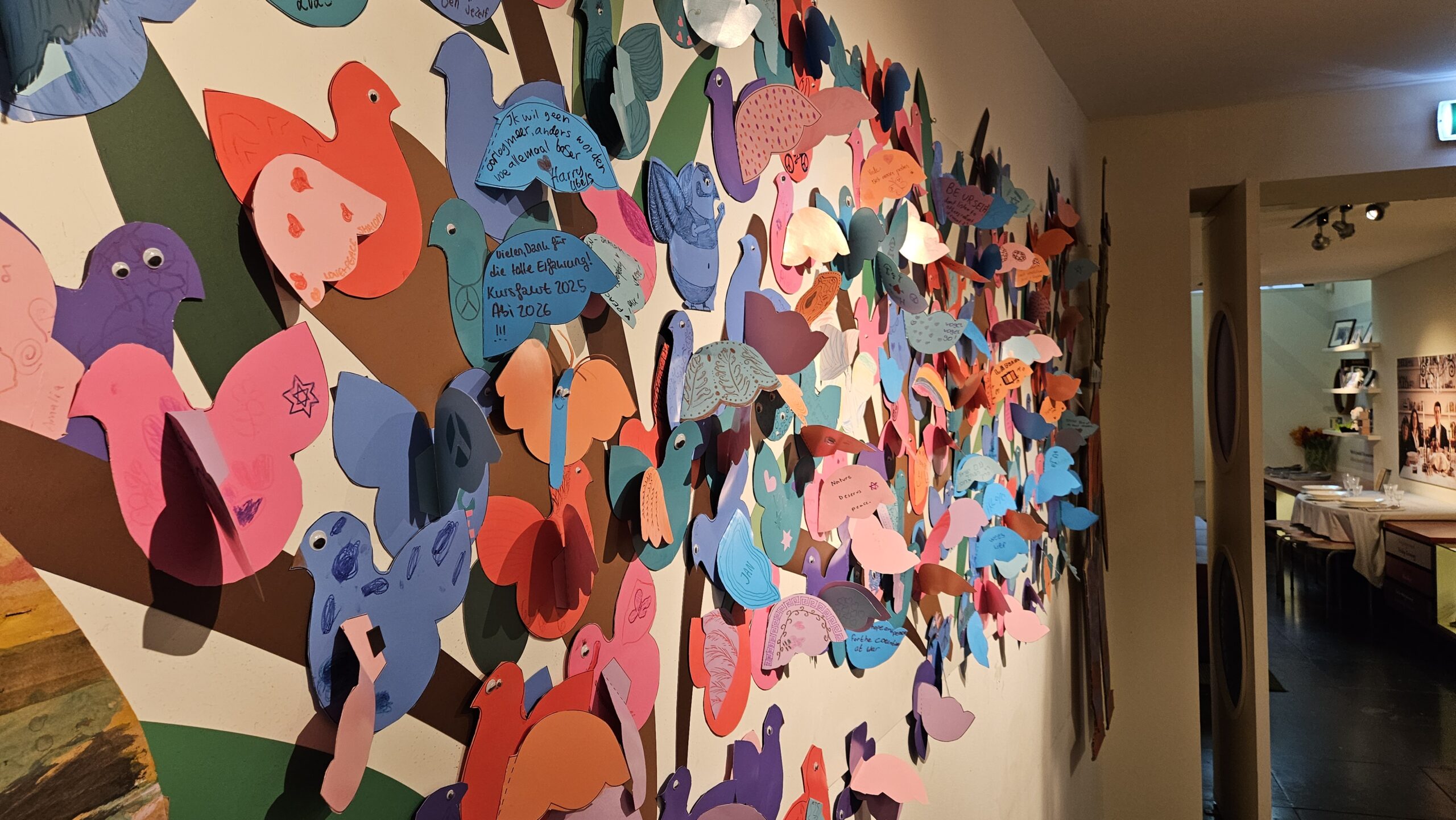
Although, according to the information panels, I am in the house of the Hollander family, at first this space feels more like an art classroom: in the middle stands a colorful table with craft supplies, and at the back there is a counter with paint and brushes. The wall on the right is covered with colorful paper peace doves.
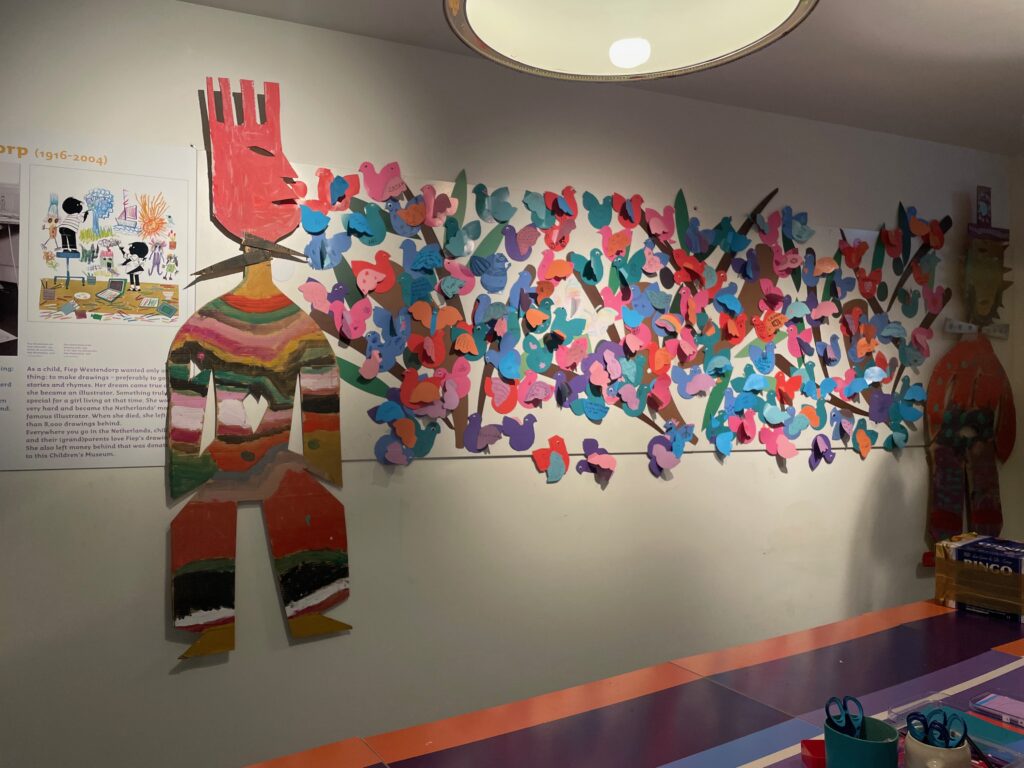
When you step closer, you see the messages that visitors to the Jewish Museum Junior have left through their peace doves. Although the instructions only explain how to craft a dove, most of the doves contain writing. The content varies: greetings from different countries, Hebrew words, or simply decorations without text. Although this installation is called the “Peace Forest,” not all of the doves carry a message about peace. Only a few doves contain specific reflections on peace: “Love, hope and peace for the countries at war,” “End to Antisemitism in Holland,” and finally a now familiar political symbol—a dove with the text “Peace Now.”
This is just one of the many ways the Jewish Museum Junior uses participation, addressing both lighter and heavier themes. Various forms of participation fit into this: from pressing buttons, crafting, and watching videos to learning to write Hebrew, playing musical instruments, and baking Jewish food.
If we define participation as involving visitors with the subject, the Peace Forest may appear to be a somewhat less successful form of participation: many of the messages on the doves do not refer to peace. Or are the many different messages actually a sign that there are many different ways of participating? These questions make the Jewish Museum Junior an interesting case study for discussing the possibilities and challenges of what Nina Simon calls a participatory museum. To do so, I will first explain what a participatory museum entails, and then illustrate the possibilities and challenges of participation using the Peace Forest and two other installations: the “Garden of Eden” and the “memory wall.”
What do we mean when we talk about participation? In 2009, Nina Simon wrote about this in her book The Participatory Museum. She argued that museums should become less passive: not a place about or for something or someone, but a place created and developed together with visitors. This means visitors bring their own ideas and contribute to the museum themselves, and they can share their experiences, which fosters a greater sense of connection with others.
According to Simon, a problem with “traditional” museums was that visitors’ own perspectives and contexts were often missing; participatory museums could change that. This idea was confirmed in my conversation with Petra Katzenstein, head and initiator of the Jewish Museum Junior. In 2000 she founded the children’s museum because the Jewish Museum did not offer enough space for children. The first “experiment” was immediately participatory: “for children it should be a place where you don’t just walk past and look at beautiful things, but hands-on.” In addition, there is a varied range of cultural elements that are always linked to general emotions and experiences, so that visitors can recognize themselves in them regardless of their background.
Specifically for children, play and participation are effective and enjoyable methods for learning. Children’s museums, however, are not amusement parks: they are also centers of cultural knowledge. The risk of focusing too heavily on participation is that this element can be lost. Finding the balance between fun, interaction and play, and responsibly conveying information is a complex task. You have to take children seriously and trust that they understand nuance, or as Katzenstein says: “address children where they are, in an adult way.” The Jewish Museum Junior indeed does this: Jewish identity is presented in its many facets, children are encouraged to ask questions and think about different interpretations of passages from the Bible and Talmud, and then share their own perspectives.
Not all forms of participation lead to nuanced reflection. Sometimes they result in irrelevant or unwanted expressions, such as the doves in the Peace Forest that say nothing about peace. The most successful example seems to be the new installation, the Garden of Eden, which is fully centered around the Golden Rule. This is a first attempt at renewing the museum. Its success largely seems to lie in the directed guidance of participation—also known as scaffolding—which is missing in other installations.
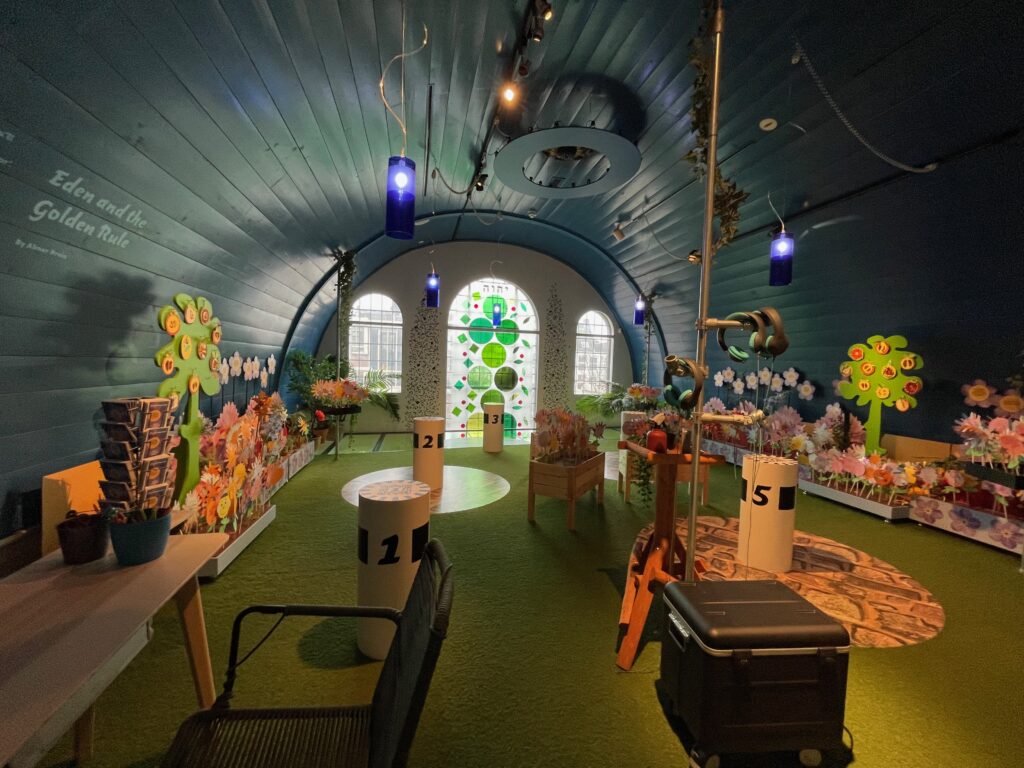
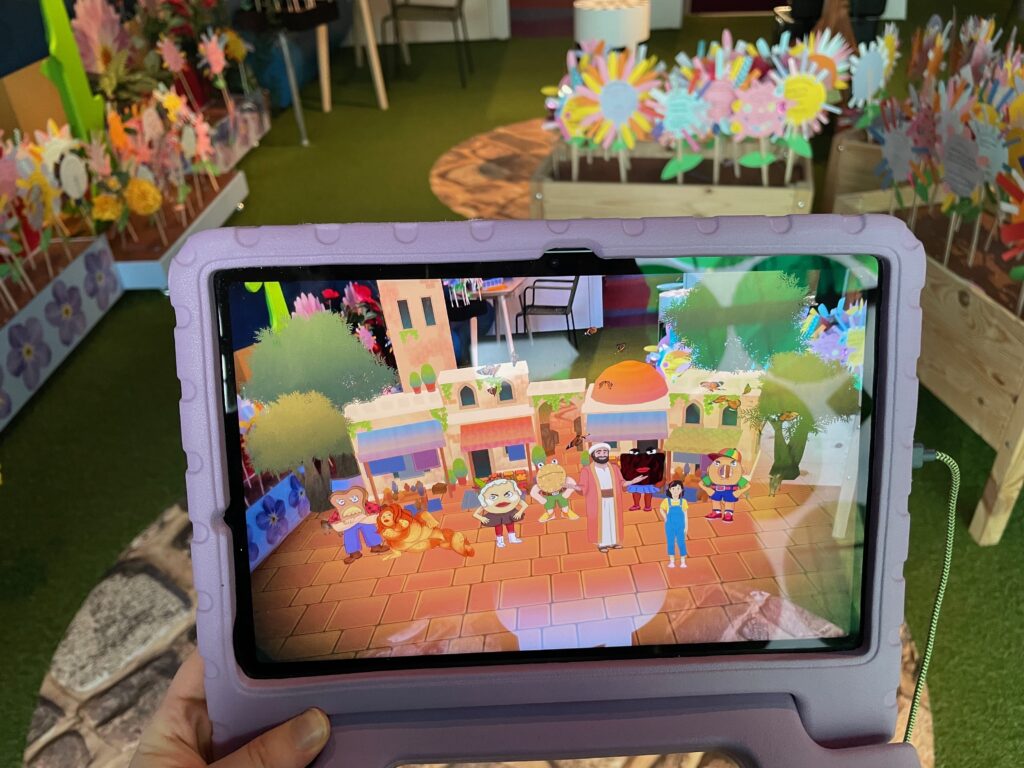
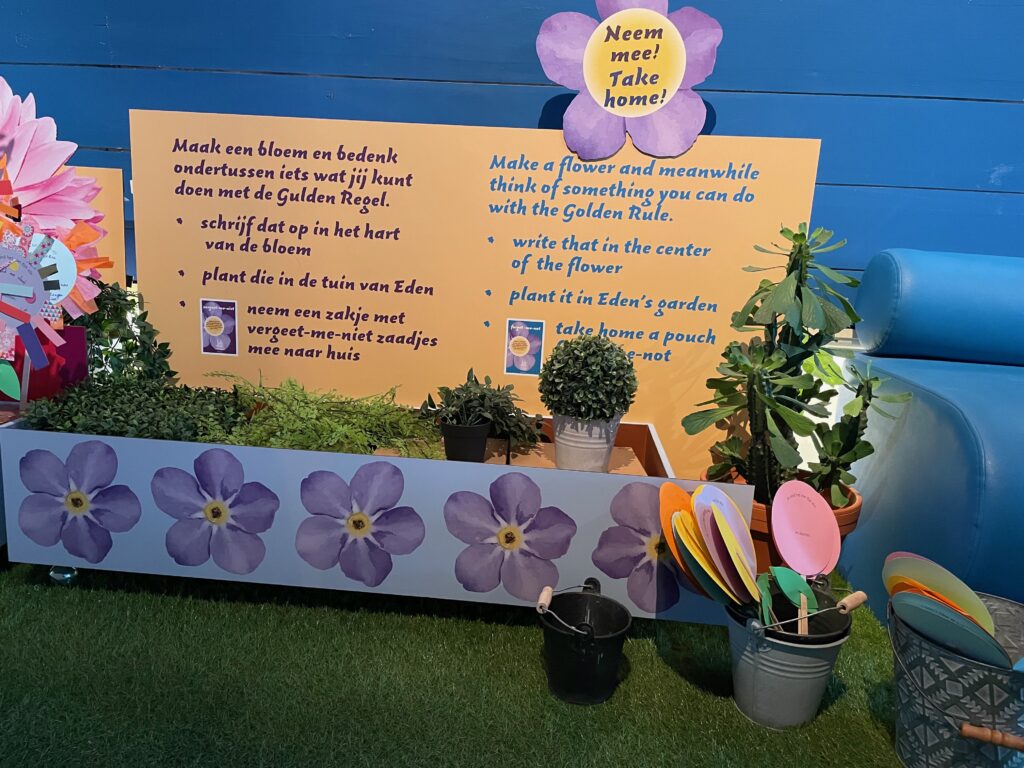
The Garden of Eden on the top floor is filled with colorful paper flowers. There are several poles with QR codes for a game on VR glasses and tablets in which animated rabbis explain the Golden Rule. Visitors can then craft a flower and write on it to apply this rule. Even without the game, this installation is a successful example in which participation is central: without visitor participation there would be no flower garden, only a few example flowers. The flowers contain guiding texts that allow room for personal interpretation but not so much that visitors become distracted from the topic:
“I don’t like it when:
and therefore:”
This guidance was only added after it became clear that a blank sheet of paper did not work well. With limited instructions, the necessary connection between the activity and the content of an installation is missing. It can even have the unintended effect that visitors with little museum experience and visitors from other cultures experience the museum visit as stressful, for fear of breaking unwritten rules. Through the guiding texts on the flowers, children learn to apply the Golden Rule and the room gradually fills like a paradise with good intentions. Afterwards, you can take home your good intentions, along with a small bag of forget-me-not seeds.
This does not mean that the strong scaffolding in the Garden of Eden always produces the desired outcomes: here too there are generic “greetings from” messages, and here too I noticed several inappropriate or (too) intense messages that were absent during later visits. During my first visit, for example, there was a text on the memory wall that referred to child abuse.
This shows that there are limits to the degree to which participation and visitor experiences can be guided. People who use participatory methods try in various ways to ensure that participation leads to appropriate or successful results. Museum scholars Stefanie Steinbeck and Ana María Munar, for example, describe how museums often attempt to create affective atmospheres, in which the senses are stimulated to evoke certain emotions. We see this in the memory wall: a wall with an animatronic mouth that speaks in a serious, solemn tone about its memories of the Holocaust. This tone makes it very clear: this is serious, you should sit down and listen quietly. At the same time, a wall is more abstract than a person, so the experience is not too intense for a child. In this way, visitors’ emotions are guided to match the content. Emotions, however, are not static: confronting the wall can evoke not only the intended emotion but a whole sequence of emotions such as curiosity, surprise, sadness, and boredom.
This also becomes clear in the participatory part of the installation. Children are invited to write down their own unpleasant or beautiful memories and stick them on the opposite wall. In this way, children hopefully reflect more on the difficult theme, or on their own memories and their relationship to the world. Museums continuously reflect on how their participatory methods work. Some forms, for example, produce meaningful responses but result in less active participation. In that sense, the memory wall is a successful form of participation, but it can also be improved. Katzenstein would like the participation not to stop at remembering: in Jewish tradition, the idea is to remember in order to… That means thinking about something is not enough—you also have to act on it.
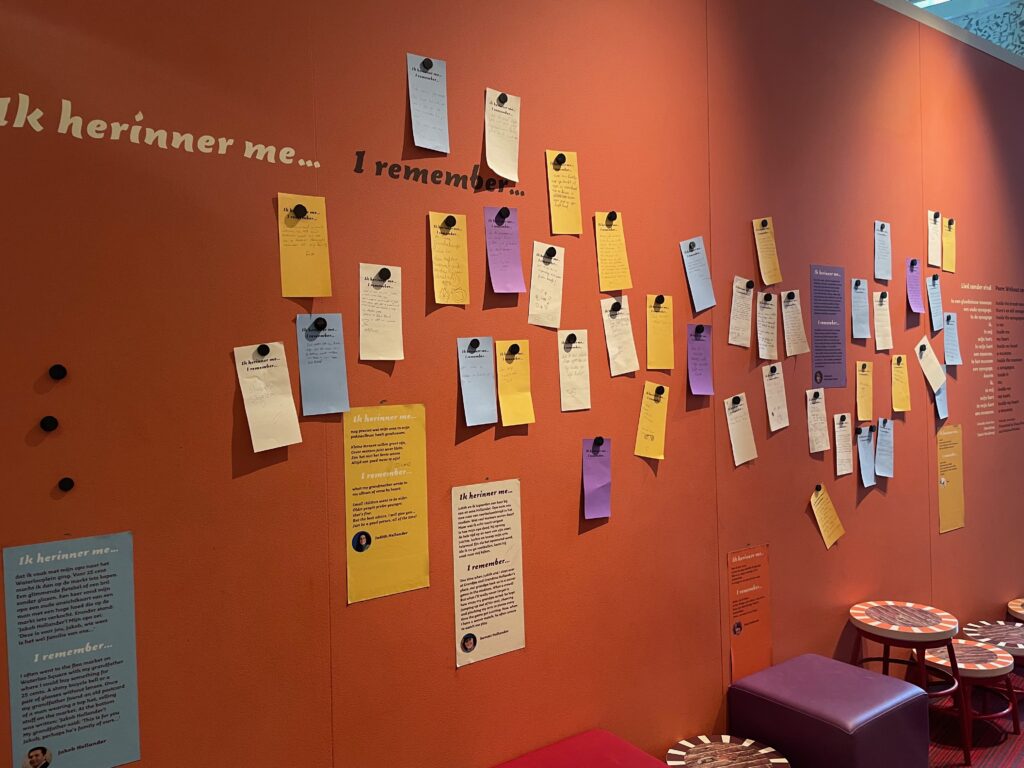
When I look at the papers, I see that indeed not all notes describe memories that can be acted upon. A blank piece of paper invites children just as easily to write about that big schnitzel they ate or the die that landed on its corner (and yes, these are real examples). This is not inherently negative: it is touching to see which everyday things can be the most important memories for a child.
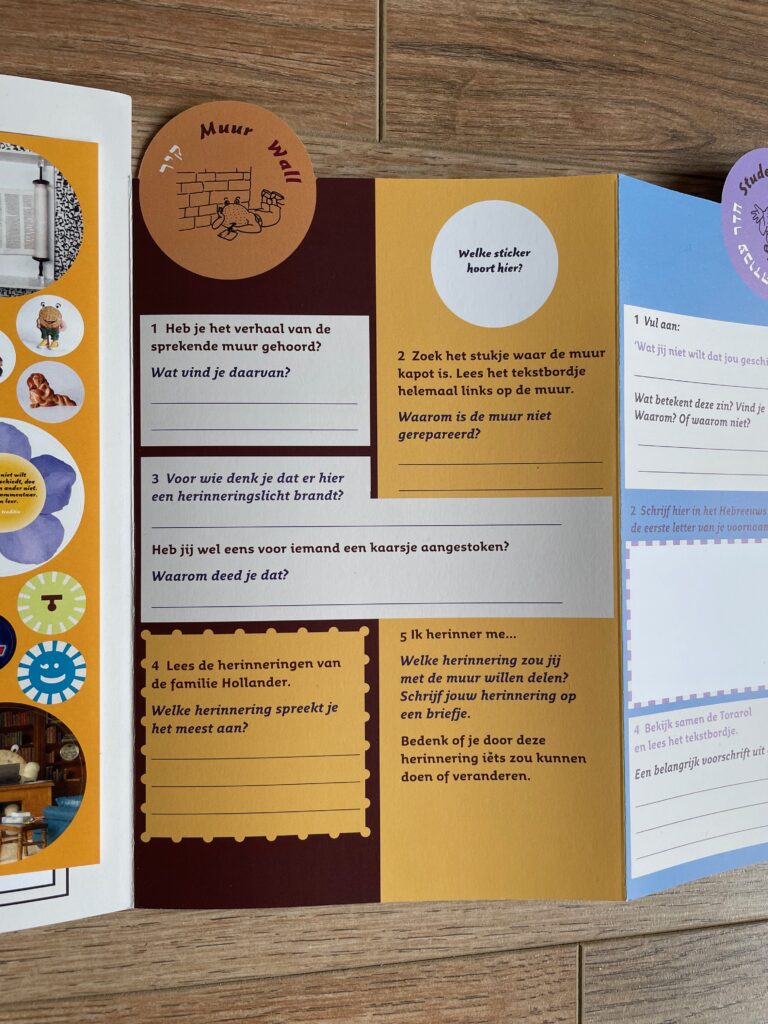
A possible cause of this limited success is the lack of scaffolding: the question “which memory would you like to be preserved?” is, besides being broad, insufficiently connected to the story of the wall. Guiding and deepening instructions for each room—such as “think about whether this memory might inspire you to do or change something”—can only be found in the booklets at the entrance. You miss that guidance and depth if you do not notice the booklets (as happened to me during my first three visits) or if their function is unclear (for example for inexperienced museum visitors). Adding these instructions to the information panels or presenting the booklets more clearly could make participation more successful.
At the same time, you do not want to explain and guide too much: you do not want to constantly prescribe to a child what and how they should do something. Moreover, a high degree of freedom during participation can contribute to facilitating interreligious knowledge and interaction. Broad questions aimed at general emotions and experiences can bridge differences between cultures and religions. Especially for children, it is valuable to give imagination space. In this sense, the broad framing of the memory wall is meaningful.
While a broad question can be a valuable alternative to strongly directed guidance, complete freedom can actually limit both children’s imagination and the success of participation. We see this in the Peace Forest: a wall full of peace doves loses its effect when so many doves deviate from the concept of peace. A broad question such as “what does peace mean to you?” might inspire children’s imagination more than a paper dove without a clear context.
These considerations become even more urgent when difficult themes are addressed. Limited guidance with distressing elements can be a deliberate choice, in order to give a child a positive experience and shield them from traumatic material. Limited guidance can also help parents decide whether and how they want to confront their children with sensitive themes. For example, the memory wall offers the possibility to reflect either on general memories or specifically on the Holocaust.
Participatory engagement with difficult themes does not have to leave an unpleasant aftertaste and can even be very valuable in giving children tools to deal with life’s complexities. In the new children’s museum, the Jewish Museum Junior aims to provide even more such tools. The Garden of Eden asks children to think about what they do not like—but it does not stop there. The real participation lies in the next step: yes, the world is not always pleasant, but you can do something about it.
 English
  Dutch
Dutch